
Baby Milestones by Month: A Gentle Guide to the First Year
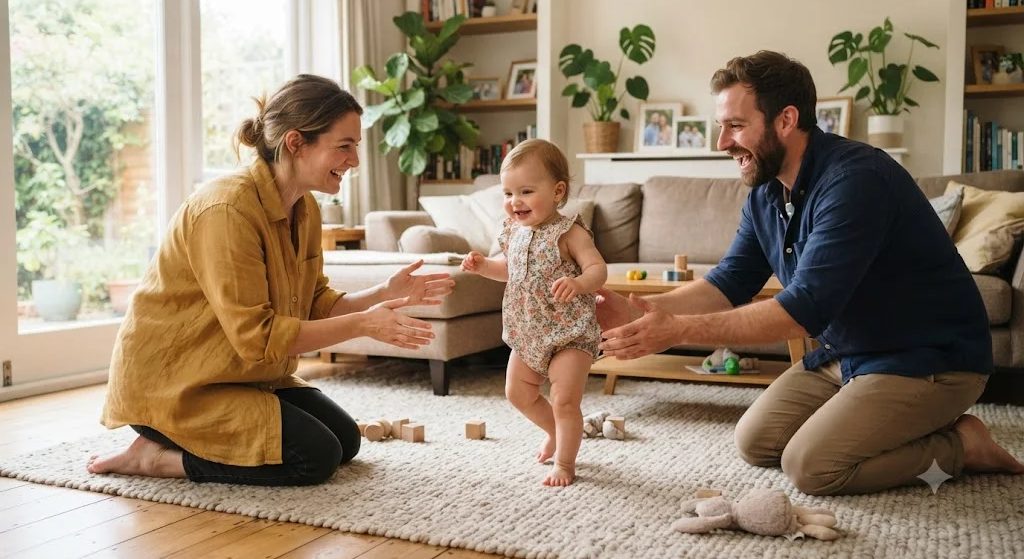
There's a moment, usually around week six, when you're bleary-eyed at 3 a.m. and your baby looks right at you and smiles. Not gas. Not a reflex. A real, whole-face smile that says oh, it's you. 💛
You'll remember the feeling forever. The date, though? That's the part that quietly slips away. This guide walks through baby milestones by month across the first year: what tends to show up when, why "on time" is a wide window, and easy ways to write each one down while it's still fresh.
Before the list: every baby has their own calendar
Milestone charts are maps, not deadlines. Some babies roll at three months and don't crawl until ten. Some skip crawling entirely and go straight to walking. Babies born early often reach milestones closer to their adjusted age (counted from their due date).
So read the months below as "around this time, many babies start to…" rather than a test. Your pediatrician checks development at regular visits and is the right person to ask if something worries you. Trust that feeling and ask; it's never a silly question.
You won't remember every day of the first year. But you can remember the days that changed everything.
Baby milestones by month: the first year at a glance
Month 1: getting to know the world
- Turns toward familiar voices, especially yours
- Focuses on faces close up (about the distance from your arm to your face)
- Brief moments of lifting the head during tummy time
Worth writing down: the first time they calmed down just from hearing your voice.
Month 2: the first real smile
- Social smiles, often the headline moment of the early weeks
- Cooing and little "ooh" and "aah" sounds
- Starts following moving things with their eyes
Worth writing down: who got the first smile, and where you were. (Families love arguing about this one later. 😄)
Month 3: hello, hands
- Discovers their own hands and watches them with total fascination
- Holds the head up more steadily during tummy time
- Smiles back when you smile
Month 4: giggles and grabbing
- The first laughs, often at something completely silly
- Reaches for toys and brings things to the mouth
- May start rolling from tummy to back
Worth writing down: what made them laugh the first time. It's usually something you'd never guess.
Month 5: the busy body
- Rolls over more often, sometimes both ways
- Blows raspberries and makes new sounds
- Pushes up on straight arms during tummy time
Month 6: sitting up and starting solids
- Sits with support, and some babies briefly on their own
- Babbles strings of sounds ("ba-ba", "da-da" without the meaning yet)
- Many families start first foods around now, following their pediatrician's advice
Worth writing down: the first food, and the face they made. Take a photo. You'll want it. 🥄
Month 7: object detectives
- Passes toys from one hand to the other
- Looks for something that's been dropped
- Responds to their own name
Month 8: on the move
- Scooting, rocking on hands and knees, or the classic army crawl
- Notices strangers and may cling to familiar people
- Enjoys peekaboo, which suddenly becomes the best game in the world
Month 9: sitting tall and pulling up
- Sits steadily without support
- May pull up to stand on furniture
- Uses fingers to "rake" small pieces of food
Worth writing down: the first time they reached for you to be picked up.
Month 10: pointing and waving
- Waves bye-bye (sometimes at the wrong moment, which is part of the charm)
- Points at things they want or find interesting
- Cruises along the sofa while holding on
Month 11: understanding more than they can say
- Follows simple words like "no" or "where's the ball?"
- Stands alone for a second or two
- Copies sounds and gestures
Month 12: first words, first steps (or soon)
- Many babies say a first word or two, like "mama", "dada", or a word that only your family understands
- Some take first steps now, others in the next few months; both are completely normal
- Plays simple games like rolling a ball back and forth
Worth writing down: the exact first word, even if it's "duck" or "uh-oh". Especially if it's "uh-oh."
Why recording baby milestones matters more than you think
In the moment, every milestone feels unforgettable. Six months later, the details blur together: was it the first wave or the first clap at Grandma's? Did they crawl before or after the trip?
Writing milestones down gives you three things:
- A true story of your child. Not just "they walked at 13 months" but where, toward whom, and what everyone shouted.
- Something to share. Grandparents and family far away feel included when they see each little step as it happens.
- A gift for later. One day your child will ask, "What was I like as a baby?" You'll have real answers, not guesses.
If time feels like it's running through your fingers, you're not alone; we wrote about that feeling in They Grow Up So Fast.
5 simple ways to keep a baby milestone tracker (that you'll actually keep)
1. Write it the same day, in one line
Don't wait to write a beautiful paragraph. "Oct 16: rolled over on the play mat, then looked shocked" is perfect. Short notes get written; long ones get postponed.
2. Always add a photo or a short video
A ten-second clip of the first wobbly steps is worth more than any description. Put the date on it right away, before it disappears into thousands of other pictures. (Our guide on how to organize baby photos has a simple monthly system.)
3. Take a "monthly photo" in the same spot
Same chair, same blanket, same teddy bear for scale, around the same date each month. Put twelve of them side by side at the first birthday and watch a whole year happen in seconds. 📸
4. Track the little numbers too
Height and weight from doctor visits, first tooth, first haircut. They seem boring now. Later they become some of the most fun things to look back on.
5. Keep it in one place that's easy to share
Notes in one app, photos in another, a paper baby book in a drawer: that's how memories get lost. Pick one home for everything, and make it easy for family to see.
A calmer way to keep all of it: My Little Keep 🌱
My Little Keep was made for exactly this problem: milestones scattered across phones, family chats, and half-filled notebooks.
My Little Keep gives your child their own private website (like name.mylittlekeep.com), with no app to install. Add a photo or video with a short note, and your baby's age is added automatically, so "first smile" sits right where it happened on the timeline.
With the Family plan, the Growing section keeps height and weight, a list of milestones, and a photo-a-month flipbook that turns those monthly pictures into a little moving story of the year. Grandparents can follow along with just the link and a 6-digit PIN, and family can leave hearts and comments.
It stays private: invite only, not on Google, no ads, and your photos are never used to train AI. You can download everything as a .zip any time.
The milestone nobody puts on the chart
Somewhere between the first smile and the first step, there's a quieter milestone: the day you realize you've stopped counting weeks and started counting months, and the newborn is gone, replaced by a little person with opinions.
You don't have to catch every moment. Just catch enough of them that, years from now, you can open it all up and say: look how far you came. 👶
More to read
 The First Year of Parenthood: What No One Tells You (and What Helps)The first year of parenthood is exhausting, tender and over in a blink. What it really feels like, plus small ways to get through it and remember it.Read more →
 How to Share Baby Photos Privately With Family (Easy Guide)How to share baby photos privately with family: 6 simple options compared, a 15-minute setup plan, and kind house rules that keep everyone close.Read more →
 Grandparents Living Far Away: Keeping Love Close Across the MilesGrandparents living far away miss so much. Here are warm, practical ways to help them know your child, feel part of every week and stay close across the miles.Read more →